• Link to Facebook
  • Link to X
  • Link to LinkedIn
  • RSES 2019-2031
  • EU Programme Open Calls
  • News
  • Contact
  • Home
Eastern & Midland Regional Assembly
  • About
    • Regional Profile
    • EMRA Members
    • EMRA Staff
    • Careers
  • Corporate
    • Corporate Plan
    • EMRA Meetings
    • Annual Reports
    • Budgets
    • Corporate Returns
    • Legal Notices
  • Planning & Economic Development
    • RSES 2019-2031
      • RSES
      • Making the RSES: Strategy Stages
      • Dublin MASP
      • RSES Implementation
      • RSES Monitoring
    • Regional Development Monitor
    • Economic Development
    • Submissions made by EMRA
      • Planning Submissions by Local Authority
      • LECP Submissions
      • Government Department and Agency Submissions
    • Policy and Research: Reports and Resources
    • Archive
  • EU Affairs
    • EU Programmes
      • URBACT
      • European Urban Initiative (EUI)
      • Other EU-Funded Programmes
    • EU Projects
      • ORIGINN
    • EU Programme Open Calls
  • EU JTF
    • EU JTF Territory
    • What the EU JTF supports
    • How to get involved
    • EU JTF Open Calls
    • EU JTF Programme Monitoring Committee
    • Beneficiaries of EU JTF Funding
    • EU JTF Publications and Documents
    • EU JTF Informative Videos
    • EU JTF Latest News
  • IREO & CoR
  • Click to open the search input field Click to open the search input field Search
  • Menu Menu
  • Home
  • About
    • About EMRA
    • Regional Profile
    • EMRA Members
    • EMRA Staff
    • Careers
  • Corporate
    • Corporate
    • Corporate Plan
    • EMRA Meetings
    • Annual Reports
    • Budgets
    • Corporate Returns
    • Legal Notices
  • Planning & Economic Development
    • Planning & Economic Development
    • RSES 2019-2031
    • Regional Development Monitor
    • Submissions made by EMRA
    • Policy and Research: Reports and Resources
  • EU Affairs
    • EU Affairs
    • EU Programmes
      • URBACT
      • European Urban Initiative (EUI)
      • Other EU-Funded Programmes
    • EU Projects
      • ORIGINN
    • EU Programme Open Calls
  • EU Just Transition Fund
    • EU Just Transition Fund
    • EU JTF Territory
    • What the EU JTF supports
    • How to get involved
    • EU JTF Open Calls
    • EU JTF Programme Monitoring Committee
    • Beneficiaries of EU JTF Funding
    • EU JTF Publications and Documents
    • EU JTF Informative Videos
    • EU JTF Latest News
  • IREO and CoR
  • Contact

Reclaim the Economy Week 2026

It is Reclaim the Economy Week (26th January – 1st February 2026) and events are being held around the world to raise awareness and spark creative ideas about how to ensure that our economy serves us better. As the 21st century unfolds, we are facing unprecedented challenges like climate change, wealth inequality, and the impact of advanced technologies on work. Reclaim the Economy encourages the exploration of emerging models of sustainable economic development that seek to respond to perceived limitations in the current economic system and propose solutions to today’s complex challenges.

To that end, a webinar was held on the 27th of January 2026 to introduce key concepts in new economic thinking like the Wellbeing Economy, Doughnut Economics, Post-Growth, and the Care Economy. Organised by Feasta (Foundation for the Economics of Sustainability) and the Wellbeing Economy Alliance, the webinar opened with reflections on the current state our economic system from Mark Garavan of Feasta. He emphasised the “carelessness” embedded in our economy, from the disposability of single-use products that saturate our waste streams to the loss of human life in wars waged for resources. Our economic system has fostered “atomised individualism”, a state in which people are presumed to ruthlessly pursue their individual self-interest. We know, however, that humans are communal animals and that cooperation and care are key to our success as individuals, as communities, and as a species. This is where new economic ideas can fill in the picture, not only to more accurately reflect the reality of our human condition, but to better address our needs. Organised by Cultivate, Feasta (Foundation for the Economics of Sustainability) and the Wellbeing Economy Alliance, the webinar opened with reflections on the current state of our economic system from Mark Garavan of Feasta. Cultivate’s website is https://cultivate.ie

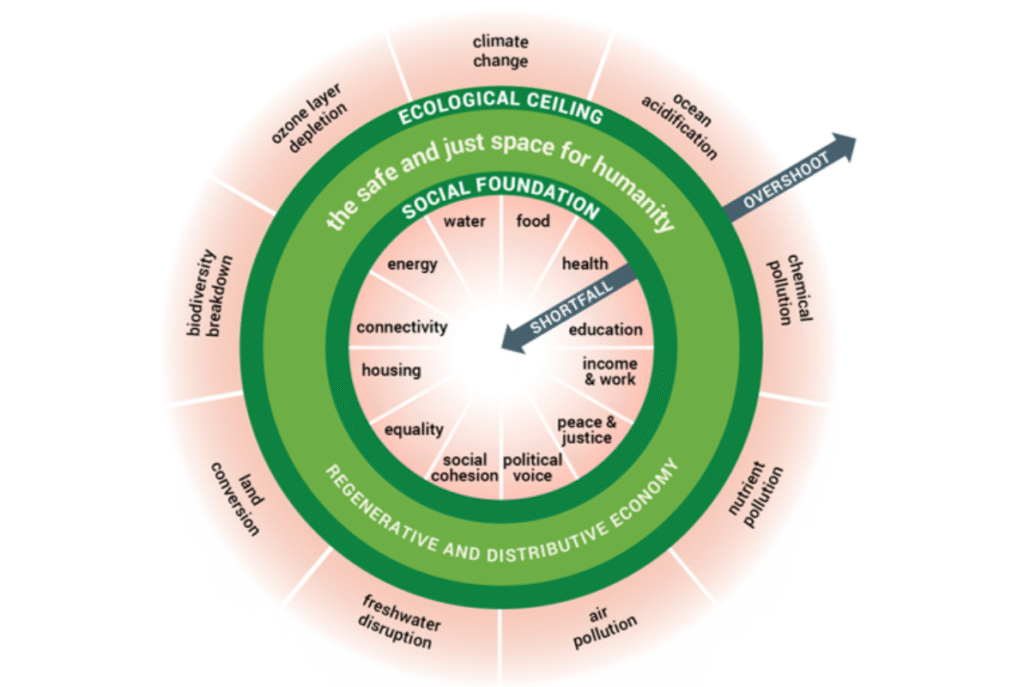
Garavan spoke of “care-full” economies as an alternative, in which the value of care is recognised and the health and wellbeing of people and planet are prioritised. The webinar featured a discussion of Doughnut Economics, a framework for thinking about economic development that respects both social and planetary boundaries. The main goal of an economy based on this model is to maintain a sustainable equilibrium that rests on a strong social foundation and respects the limits of the planet’s finite resources. The Wellbeing Economy was also discussed, a model focused on designing economic rules and incentives to ensure that everyone has enough to live in comfort, safety, and dignity. The Wellbeing Economy moves the focus from economic growth (GDP growth) to people-centred wellbeing (health, environmental regeneration, participation, fairness, purpose).

A lot of these new schools of thought on economic development are moving away from GDP-growth as the ultimate measure of a strong economy. The GDP-centric nature of our current economic system leaves out a lot of what is important to us as a society. Vanessa Conroy of the National Women’s Council presented a stark example during the webinar; women in Ireland collectively do 38 million hours of unpaid care work weekly, adding at least €24billion of value, or 12.3% of the total Irish economy. This shows the valuable contribution of this work to the economy but, despite that, it is largely invisible in the accounting of our current economic system.

Post-Growth, sometimes referred to as Degrowth, has been criticised for being anti-economic development, but this is a fundamental mischaracterisation of the concept. As Roisin Markham of the Irish Doughnut Economics Network outlined during the webinar, it’s not about being “anti-growth” but rather about not pursuing a narrow definition of economic growth at all costs – that other considerations for our flourishing as individuals and communities must be taken into account. It is the difference between “more” and “better.” The term degrowth comes from the French word décroissance, which means reduction or diminution. It is derived from the analogy of a river returning to its natural flow after a disastrous flood in which the water exceeds its bounds. Like other new economic models, Degrowth emphasises the need for our economy to roll back the damaging impact of over-consumption, to stay safely within our ecological limits.

In its 2023 Climate Change Assessment Synthesis Report, the EPA found that “fairer and more equal societies are more resilient to impacts (of climate change) and are more likely to adopt progressive transformative policies. Prioritisation of wellbeing and equity in development and climate policy could bolster the democratic social contract in support of transformation, including improved quality of life, decent work and the value of care.”

The novel challenges we face in the 21st century will force transformation on us, one way or another. New approaches to economic policy are a key part of taking control of that transformation. With the right policies in place, we are better positioned to ensure a just transition for long-term human wellbeing. Business-as-usual risks exposing us to a future in which we are unprepared to deal with existential threats. This webinar was held as part of Feasta’s ongoing initiative to enhance economic literacy. This initiative encourages us to ask difficult questions about things we have taken for granted, assumptions we have accepted for decades. Have our policies for economic development been oriented towards the right goals?  Does economic success require environmental harm? How can we have infinite economic growth on a planet with finite resources? New models of sustainable economic development frame answers to these questions with ambitious, creative, and transformative new thinking.

Share this entry
  • Share on Facebook
  • Share on X
  • Share on WhatsApp
  • Share on Pinterest
  • Share on LinkedIn
  • Share by Mail
https://www.emra.ie/wp-content/uploads/2026/01/Douhgnut-Economics-image-1.png 618 581 Cara Farrell https://www.emra.ie/wp-content/themes/master/images/emra-logo-2024.png Cara Farrell2026-01-29 15:47:182026-02-12 09:31:51Reclaim the Economy Week 2026

News

  • Supporting a Sustainable Transition through climate Action for a Resilient Territory (START) Scheme
    Supporting a Sustainable Transition through climate Action for a Resilient Territory (START) Scheme
    February 16, 2026
  • EMRA to participate in Regional Studies Association Annual Conference on ‘Compact ‘Growth at University College Cork
    EMRA to participate in Regional Studies Association Annual Conference on ‘Compact ‘Growth at University College Cork
    February 12, 2026
  • Press Release – EMRA Calls for Urgent Review of Transport Investment Plan
    Press Release – EMRA Calls for Urgent Review of Transport Investment Plan
    February 4, 2026
  • Call for Social Innovation Projects: Share Your Community Impact with ELIF
    Call for Social Innovation Projects: Share Your Community Impact with ELIF
    February 3, 2026
  • Students sponsored by EMRA and EU Just Transition Fund visit the European ParliamentGraduate.ie
    Students sponsored by EMRA and EU Just Transition Fund visit the European Parliament
    January 14, 2026
  • Just Transition Fest celebrates EU Just Transition Fund Impact
    Just Transition Fest celebrates EU Just Transition Fund Impact
    November 18, 2025
  • Policies for People and Places – Interreg Event for Knowledge-Sharing
    Policies for People and Places – Interreg Event for Knowledge-Sharing
    November 17, 2025
  • Smart and Sustainable Mobility Accelerator Track 3: Academia and Innovation Actors took place in TU Dublin on 22 October 2025
    Smart and Sustainable Mobility Accelerator Track 3: Academia and Innovation Actors took place in TU Dublin on 22 October 2025
    November 14, 2025
  • European Week of Regions and Cities 2025 – Strengthening Policy Alignment and Stakeholder Engagement
    European Week of Regions and Cities 2025 – Strengthening Policy Alignment and Stakeholder Engagement
    November 10, 2025
  • ORIGINN Study Visit to Bologna, Emilia-Romagna Region
    ORIGINN Study Visit to Bologna, Emilia-Romagna Region
    November 4, 2025
All News

Quick links

  • About EMRA
  • RSES 2019-2031
  • EU Just Transition Fund
  • URBACT
  • European Urban Initiative (EUI)
  • News
  • EU Programme Open Calls
  • Regional Development Monitor
  • Sustainable Mobility Academy
  • Association of Irish Regions

Our work and functions

  • Corporate
  • Planning & Economic Development
  • EU Affairs
  • IREO and CoR
  • EU Just Transition Fund

Contact EMRA

Eastern and Midland Regional Assembly
3rd Floor North, Ballymun Civic Centre
Main Street, Ballymun
Dublin 9, D09 C8P5
Ireland

+353 (0) 1 8074482

info@emra.ie

Gov IRL LogoCo funded by EU LogoEMRA Logo

© EMRA 2026
  • Cookies
  • Privacy
  • Anti-fraud Statement
Scroll to top Scroll to top Scroll to top

This site uses cookies. By continuing to browse the site, you are agreeing to our use of cookies.

Accept All CookiesManage PreferencesNecessary Cookies Only

Cookie and Privacy Settings


Our use of cookies

We use necessary cookies to make our site work. We'd also like to set optional analytics cookies to help us improve it. We won't set optional cookies unless you enable them. Using this tool will set a cookie on your device to remember your preferences.

For more detailed information about the cookies we use, see our Cookies Page

Necessary Website Cookies

Necessary cookies enable core functionality such as security, network management, and accessibility. You may disable these by changing your browser settings, but this may affect how the website functions.

Google Analytics Cookies


We'd like to set Google Analytics cookies to help us to improve our website by collecting and reporting information on how you use it. The cookies collect information in a way that does not directly identify anyone.

Other external services

We also use different external services like Google Webfonts, Google Maps and external Video providers. Since these providers may collect personal data like your IP address we allow you to block them here. Please be aware that this might heavily reduce the functionality and appearance of our site. Changes will take effect once you reload the page.

Google Webfont Settings:

Google Map Settings:

Vimeo and Youtube video embeds:

Privacy Policy

You can read about our privacy policy in detail on our Privacy Policy Page.

Privacy
Accept settingsHide notification only
Open Message Bar Open Message Bar Open Message Bar