
Driving Urban Regeneration by Mainstreaming the New European Bauhaus (NEB)

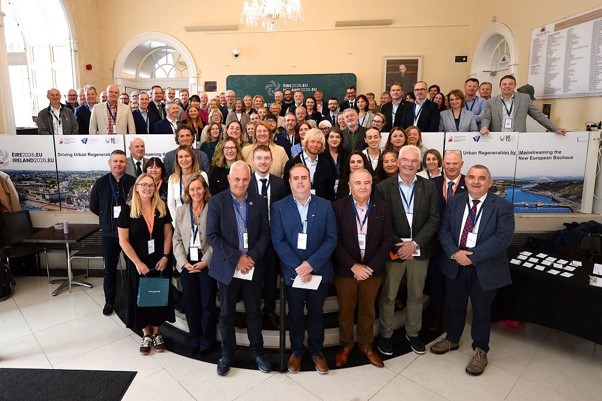
The Urban Contact Point for Ireland, Karl Murphy, Eastern and Midland Regional Assembly, participated in a two-day conference on sustainable urban development titled ‘Driving Urban Regeneration by Mainstreaming the New European Bauhaus’ at Theatre Royal in Waterford on October 6 and 7.
The two-day conference was an Associate Event under Ireland’s Presidency of the European Council and was co-organised by the Southern Regional Assembly, Waterford City and County Council and the South East Technological University. The event brought together local, regional, national and European practitioners and specialists to discuss and advise on how best to deliver the New European Bauhaus (NEB) values of beauty, inclusion and sustainability in future urban regeneration and in Cohesion Policy both in Ireland and more widely in Europe. More distinctly, the conference focused on the challenges and opportunities inherent in mainstreaming NEB principles into urban regeneration policy.
Day One saw a focus on Ireland’s experience of sustainable urban development (SUD) delivery with a focus on Town Centre First, heritage-led regeneration and compact growth. The event kicked off with a keynote video address by Raffaele Fitto, Executive Vice-President, of the European Commission, before attendees were taken through a series of quick-fire presentations on how NEB principles are already integrated into policy and practice, including hearing from David Kelly (Director at the Southern Regional Assembly), Eamon Ryan (Chair of the European Housing Advisory Board), Iulia-Mirela Serban (Head of Coordination of Programmes, DG REGIO, European Commission), Stewart Logan (Senior Advisor, DHLGH), Dr Robin Stubbs (South East Technological University); as well as Morris Conway (Senior City Architect at Waterford City and County Council) who inspired attendees with an overview of the Viking Triangle as a case study of Heritage and the NEB as a Tool for Urban Regeneration!
A panel discussion next focused on ‘how the Irish Model Mainstreams New European Bauhaus in Urban Regeneration and compact growth and how this could be replicated In Europe’ before Waterford’s Chief Executive Sean McKeown wrapped up day one’s contributions with a summary of insights and takeaway messages. Attendees concluded day one by embarking upon a number of site visits, comprising Reginald’s Tower, King of the Vikings Experience, the Medieval Museum, Tir na nÓg @ Lady Lane, and the Bishop’s Palace.
While day one was more focused on the Irish experience to date, day two looked to the future and at building upon the success of the Irish model by utilising the NEB as a policy lever to navigate and leverage EU funding, looking ahead to the future MFF.
A range of presentations looked at among other topics, equality and human rights (Ian Murphy and Bernie Bradley from the Irish Human Rights & Equality Commission) citizen participation (Mayor John Moran of Limerick), and the emerging New European Bauhaus Facility (Sophia Vlieger de Oliveira, Policy Officer for NEB, Joint Research Centre, European Commission), as well as a presentation on ‘Research and Development supporting the New European Bauhaus and Urban Regeneration’ (Philip Cheasty, National Contact Point (NCP) for Horizon Europe Custer 5).
In addition to the above contributions, day two of the conference saw a presentation on research undertaken by Eileen Crowley, Eleni Feleki, & José Costero. The URBACT Urban Regeneration Experts undertook an URBACT funded study on behalf of the Department of Housing, Local Government and Heritage, titled ‘Unlocking Compact Cities – Strengthening Integrated Urban Regeneration through THRIVE, NEB and European Learning’

European Urban Initiative (EUI) and URBACT, Karl Murphy as part of a panel on ‘Integrating the NEB Facility into Ireland’s Urban Regeneration Model: Looking Towards the Next MFF’. Karl was joined by panellists from the European Commission, the South East Technological University and Waterford City and County Council. Karl detailed the importance of the EUI’s capacity building pillar (national capacity building events, peer reviews and city to city exchanges) in enabling cities to review their existing strategies and ready their cities for the future programming period.

The conference left attendees with a greater recognition of the importance of NEB principles and values in unlocking future funding opportunities and the importance of building innovative relationship inside and between organisations across academia and the various levels of governance. You can read more here.


