• Link to Facebook
  • Link to X
  • Link to LinkedIn
  • RSES Review
  • RSES 2019-2031
  • EU Programme Open Calls
  • News
  • Contact
  • Home
Eastern & Midland Regional Assembly
  • About
    • Regional Profile
    • EMRA Members
    • EMRA Staff
    • Careers
  • Corporate
    • Corporate Plan
    • EMRA Meetings
    • Annual Reports
    • Budgets
    • Corporate Returns
    • Legal Notices
  • Planning & Economic Development
    • RSES 2019-2031
      • RSES
      • Making the RSES: Strategy Stages
      • Dublin MASP
      • RSES Implementation
      • RSES Monitoring
    • RSES Review
    • Regional Development Monitor
    • Economic Development
    • Submissions made by EMRA
      • LECP Submissions
      • Planning Submissions by Local Authority
      • Government Department and Agency Submissions
    • Policy and Research: Reports and Resources
    • Archive
  • EU Affairs
    • EU Programmes
      • URBACT
      • European Urban Initiative (EUI)
      • Other EU-Funded Programmes
    • EU Projects
      • ORIGINN
    • EU Programme Open Calls
  • EU JTF
    • EU JTF Territory
    • What the EU JTF supports
    • How to get involved
    • EU JTF Open Calls
    • EU JTF Programme Monitoring Committee
    • Beneficiaries of EU JTF Funding
    • EU JTF Publications and Documents
    • EU JTF Informative Videos
    • EU JTF Latest News
  • IREO & CoR
  • Click to open the search input field Click to open the search input field Search
  • Menu Menu
  • Home
  • About
    • About EMRA
    • Regional Profile
    • EMRA Members
    • EMRA Staff
    • Careers
  • Corporate
    • Corporate
    • Corporate Plan
    • EMRA Meetings
    • Annual Reports
    • Budgets
    • Corporate Returns
    • Legal Notices
  • Planning & Economic Development
    • Planning & Economic Development
    • RSES Review
    • RSES 2019-2031
    • Regional Development Monitor
    • Submissions made by EMRA
    • Policy and Research: Reports and Resources
  • EU Affairs
    • EU Affairs
    • EU Programmes
      • URBACT
      • European Urban Initiative (EUI)
      • Other EU-Funded Programmes
    • EU Projects
      • ORIGINN
    • EU Programme Open Calls
  • EU Just Transition Fund
    • EU Just Transition Fund
    • EU JTF Territory
    • What the EU JTF supports
    • How to get involved
    • EU JTF Open Calls
    • EU JTF Programme Monitoring Committee
    • Beneficiaries of EU JTF Funding
    • EU JTF Publications and Documents
    • EU JTF Informative Videos
    • EU JTF Latest News
  • IREO and CoR
  • Contact

EUI-URBACT Information Session

The Eastern and Midland Regional Assembly (EMRA) was delighted to host its third annual joint EUI-URBACT info session at the impressive Richmond Education and Event Centre* on the 25th of March.

The EUI-URBACT info session at the Richmond was well attended by local authority staff and others from across the Republic’s three regions. Always a great networking opportunity in addition to information being imparted on calls and opportunities, there was a very positive atmosphere on the day, aided by the sun and ample natural light filling the beautiful venue.

Bernie Roe, Assistant Director at the EMRA welcomed guests, provided an overview of the day’s agenda, as well as the importance of the EUI-URBACT Contact Point role for EMRA given it marries both the planning and EU cooperation functions of the organisation. She encouraged attendees to get involved, before passing over to David Murray, Planning Advisor at the Department of Housing, Local Government, and Heritage (DHLGH). David spoke briefly about the EU Agenda for Cities, the DHLGH’s support for an integrated plan-led approach to growth, and for our local authorities to develop capacity and find new solutions to their urban challenges. David concluded by giving an update on Ireland’s preparation for the EU Council Presidency in semester 2, and the DHLGH’s role as the ministry responsible for urban and territorial cohesion policy.

Following Bernie’s and David’s words of welcome to kick the day off, Karl Murphy (EMRA), Urban Contact Point for the European Urban Initiative (EUI) in Ireland provided an overview of the EUI’s capacity building offer. With a focus on the continuous call for City-to-City Exchanges and the latest Peer Review call (open until April 22), he explained the huge potential benefits for local authority staff to avail of these free opportunities to build capacity, explore solutions to urban challenges with peers across Europe, and to build networks. Karl explained the simplicity of applying to either call and the supports available. He spoke briefly about EUI Capacity Building events, and the Portico knowledge platform before welcoming Aoife Lawler, Senior Executive Officer (Housing) at Fingal County Council.

Aoife provided an inspiring testimonial on her involvement in an EUI City-to-City Exchange with Helsinki in respect of cost rental housing. She spoke of her learnings and how this is influencing Fingal County Council’s approach and attitude to housing tenure mix! Aoife spoke of her two experiences as a Peer Review city during 2025 where she acted as a Reviewer in Sörmland, Sweden (May) and then in Malmö, Sweden (December), encouraging those in the audience to apply! Aoife is the first local authority staff member in Ireland to partake in both a City-to-City Exchange and a Peer Review. We were delighted to have her experience in the room! Karl and Aoife next sat as part of a short panel, taking a number of questions from an interested audience.

Following the EUI Capacity Building offer, we next heard from Kathleen McCarron, Senior Project Officer at the EUI Permanent Secretariat. Kathleen joined in-person from Lille and provided an overview of the new Innovative Actions (IA) call 4, as well as some excellent tips for those that plan to apply. The IA call 4, remains open until June 15 and enables eligible local authorities to pursue innovative, out-of-the-box solutions (products, processes or services) to their sustainable urban development challenge. Kathleen and Karl took questions from an interested audience.

Before breaking for lunch, Laure Antoniotti (EMRA) introduced a short video which has been produced across the last year, focusing on the EUI and URBACT offer, as well as a glimpse of EMRA’s work as Contact Point with local authorities across the three regions. The video was warmly received, and you can view this here.

After a lunchbreak of busy networking and information exchange, the afternoon’s URBACT session got underway. Karl Murphy, National URBACT Point for Ireland gave details of the brand-new URBACT call for Action Networks (open until June 17). The new call sees a greater emphasis on implementation and the move from plans and strategy to putting these into action via local pilots. 50% of the budget is available for these testing actions, and approaches to implementation will continue to be influenced and improved by each project’s transnational partners, with strong participation of local stakeholders mandatory as always when it comes to URBACT! After Karl’s presentation, attendees heard inspiring URBACT testimonials from Kitty Foyle, Senior Executive Officer (Environment) at Meath County Council and Colin Doyle, Senior Community and Social Development Officer at Dublin City Council. Kitty whose In4Green network (focused on the green and sustainable transition in the town of Navan) concluded in December 2025 spoke glowingly of the value of URBACT in “pull[ing] everyone into the same room, looking in the same direction”. She spoke of the great structure and tools that URBACT participation provides, including impactful testing actions, a governance model that works and clarity on priorities. Colin, whose project CITI4UD is only at the beginning spoke very encouragingly of his first expressions on the utility of the project. It has great potential in generating stronger community bonds and in encouraging inclusive participation in pursuit of public space enhancement and greater economic opportunity for Bluebell, South Dublin (the project’s location focus). Following Kitty’s and Colin’s lively testimonials, they were joined by Karl as part of a panel, taking questions from a curious audience.

The day concluded with some thank-you notes from Bernie Roe before the team stayed on to take questions on a bilateral basis from interested prospective applicants.

A huge thank you again to all our speakers: David, Aoife, Kitty, Colin, and a special thank you to all our attendees for what was a positive day of information exchange and networking.

You can find all resources from the day at the event page (see left panel) and you can view the gallery of photographs here.


*Based on North Brunswick Street in Dublin 7, the building was previously the Richmond Hospital until 1987, before being used for District Court sittings. It was acquired by the Irish Nurses and Midwives Organisation (INMO) in 2014, refurbished and formally opened as the Richmond Education and Event Centre in 2018. The redeveloped Richmond was shortlisted as a finalist in the Irish Construction Excellence Awards and now operates as a centre of excellence for the delivery of education courses to nurses and midwives, and in addition, the venue offers a number of rooms which can be rented for social events, small conferences and meetings.

https://www.emra.ie/wp-content/uploads/2026/03/European-Urban-Initiative-EUI-URBACT-Joint-Information-Session-130.jpg 801 1200 Cara Farrell https://www.emra.ie/wp-content/themes/master/images/emra-logo-2024.png Cara Farrell2026-03-30 15:32:322026-04-07 13:50:49EUI-URBACT Information Session

RSES Review – Strategic Issues Paper

EMRA Launches Review of the Regional Spatial and Economic Strategy (RSES)

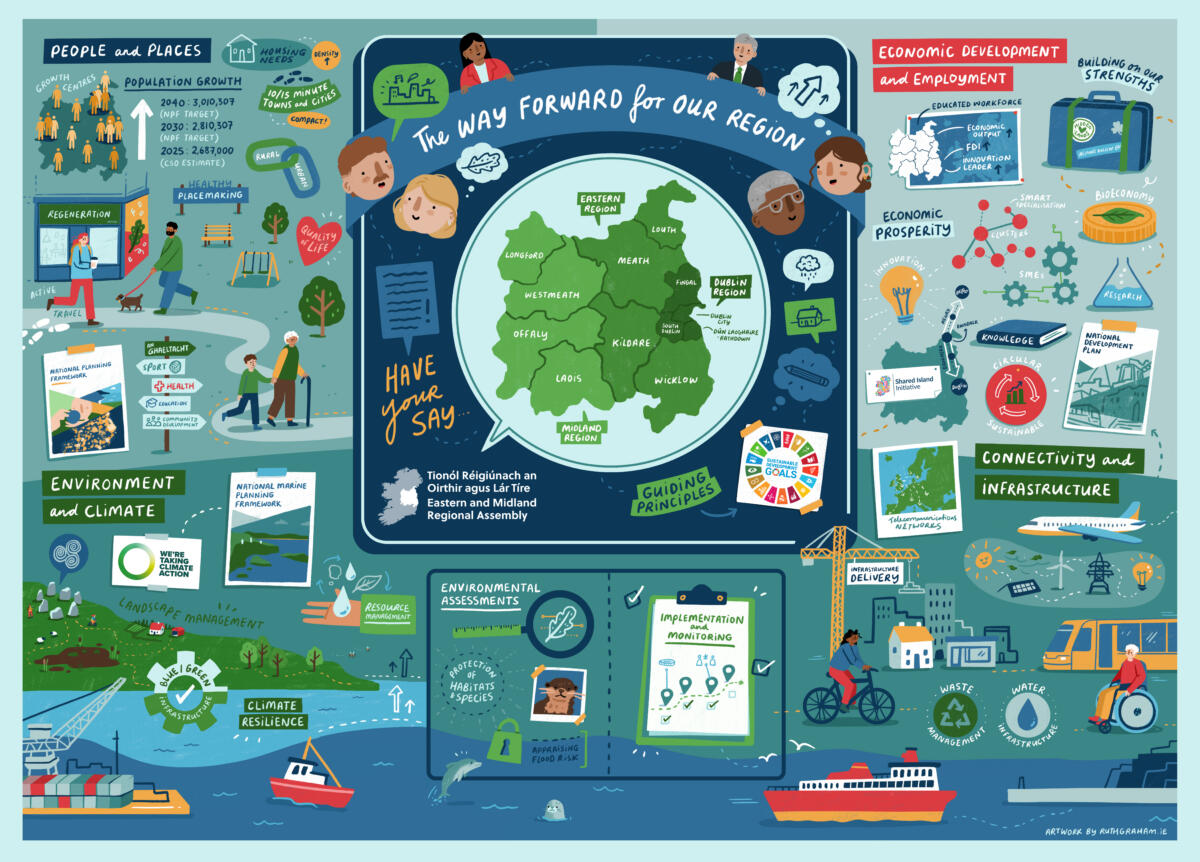
The Eastern and Midland Regional Assembly (EMRA) has formally commenced the review of the Regional Spatial and Economic Strategy (RSES) for the Eastern and Midland Region. This marks an important step in shaping a renewed vision for coordinated spatial planning, economic development, and sustainable growth across the region.

As part of this pre‑draft stage, EMRA has published a Strategic Issues Paper and is inviting individuals, communities, local authorities, state agencies and government departments to share their views on the future of the region. Feedback received will help shape the next RSES, which will guide how the region grows in terms of housing, infrastructure, climate action, economic opportunity, quality of life, and the protection of our natural and cultural assets.

Cathaoirleach Cllr. David Healy highlighted the importance of public engagement:
“The RSES is a critical framework for how our region develops, and the voices of residents, community groups and stakeholders are essential in shaping its direction. I strongly encourage everyone to engage with this process and contribute to a strategy that will guide the region’s future for years to come.”
Speaking about the commencement of the review, EMRA Director Clare Bannon said:
“This review represents a significant opportunity to set a long-term vision for a sustainable, connected and prosperous region. We are encouraging people and organisations across the Eastern and Midland Region to participate and help us shape a strategy that reflects shared ambitions for our communities, our environment and our economy.”

Drogheda, County Louth, Ireland

Submissions and observations on the Strategic Issues Paper are now invited until 5pm on Friday, 22 May 2026.

This marks the first stage of a multi‑phase consultation process, with further opportunities for engagement as the draft RSES is developed.

EMRA looks forward to working collaboratively with communities, local authorities, and stakeholders to deliver an ambitious and future‑focused Regional Spatial and Economic Strategy.


The RSES Issues Paper can be viewed and downloaded EMRA_RSES – Strategic Issues Paper v1.14
The consultation portal is now live  https://consult.emra.ie/en/consultation/pre-draft-rses-public-consultation-strategic-issues-paper


https://www.emra.ie/wp-content/uploads/2026/03/EMRA-_-Infographic-v3-large-e1775564821117.jpg 800 1200 Bernard Kenealy https://www.emra.ie/wp-content/themes/master/images/emra-logo-2024.png Bernard Kenealy2026-03-26 17:03:302026-04-07 13:33:12RSES Review – Strategic Issues Paper
Image with logos for the European Urban Initiative and URBACT

European Urban Initiative (EUI) and URBACT Information Session

Join Us for an Exciting In-Person Information Session!

EMRA, as the National Contact Point in Ireland for the European Urban Initiative (EUI) and URBACT programmes, is delighted to announce our next joint information session on 25 March at the Richmond Education and Event Centre, North Brunswick Street, Dublin.

This event is a fantastic opportunity for Irish local authority staff to discover the latest funding calls, supports, and opportunities available to help our towns and cities advance sustainable urban development.

Hear inspiring testimonials from current and past beneficiaries, gain insights into successful projects, and connect with peers and colleagues from across the sector, all in one engaging afternoon.

Register here: https://lnkd.in/dyu_SjVZ

We look forward to seeing you there and working together to shape more sustainable and resilient urban futures!

https://www.emra.ie/wp-content/uploads/2026/02/Urbact-EUI-newspost-feature-image.png 800 1200 Cara Farrell https://www.emra.ie/wp-content/themes/master/images/emra-logo-2024.png Cara Farrell2026-02-25 11:00:002026-02-27 11:06:46European Urban Initiative (EUI) and URBACT Information Session
Just Transition Funding

Ministers Heydon and O’Brien announce €10 million EU Just Transition Funding for two bioeconomy demonstration projects

Awards of €5 million each from the EU Just Transition Fund Bioeconomy Demonstration Initiative will support two bioeconomy projects with collaboration across the Midlands 

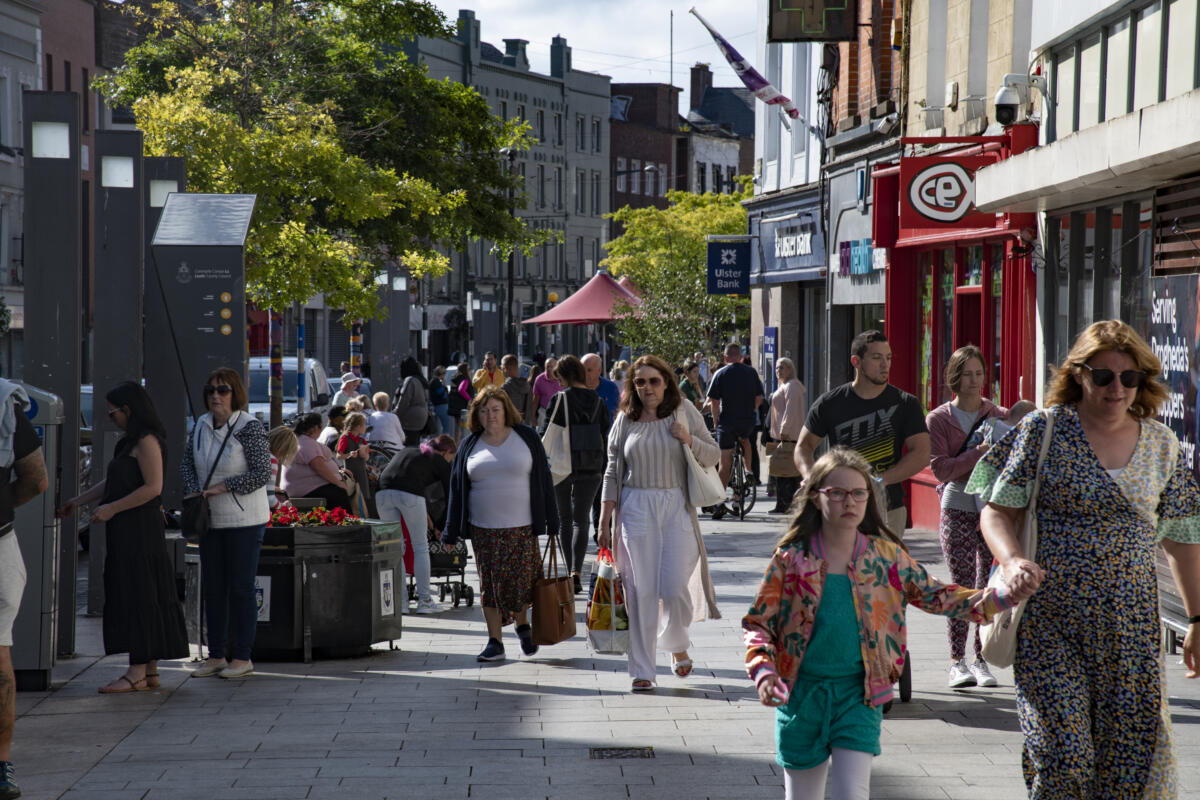
Minister for Agriculture, Food and the Marine, Martin Heydon TD, and Minister for Climate, Energy and the Environment, Darragh O’Brien TD, have today announced €10 million in funding for two bioeconomy demonstration initiatives. This is the second call under the EU Just Transition Fund Bioeconomy Demonstration Initiative, which is co-funded by the Government of Ireland and the European Union. This call is designed to deliver practical, investable bioeconomy solutions in Ireland’s Just Transition Fund Territory in the Midlands, which supports communities and businesses to build new, low-carbon biobased value chains as the region moves away from peat. Both projects will anchor their demonstration activity, biomass procurement and industry collaboration in the Midlands, generating local investment, supply-chain opportunities, and skills development.

Funding of €5 million is being awarded to the ‘BIOCHAR’ project led by University of Limerick while a further €5 million is being awarded to ‘TRANSFORM’, which is led by University College Dublin. Marking the announcement, Minister Heydon said:

“I am delighted to announce this €10 million in funding for two new bioeconomy demonstrator projects, as part of the EU Just Transition Fund. The BIOCHAR and TRANSFORM projects will demonstrate the potential uses of biochar in agriculture, bioenergy and sustainability, as well as transforming agri-food byproducts and waste into functional ingredients. This investment will build on the €22 million already committed to other bioeconomy pilot projects, demonstrating the government’s commitment to ensuring the bioeconomy is scaled up across our economy and our rural areas.”

The ‘BIOCHAR’ project will bring together a range of partners from across Ireland and leverage their experience to develop and produce a sustainable biochar product for demonstration in agriculture, water treatment, and transport infrastructure. The biochar will be produced from indigenous biomasses and tested through large-scale demonstrations in the Just Transition Fund Territory, including in agriculture, water treatment and transport infrastructure. The project will also develop a high-level blueprint for a mid-sized biochar facility to support future investment and replication in the Midlands.

Through collaboration and engagement with the Circular Food Company in the Midlands and SOMATECH, a fermentation technology provider in Ireland, the ‘TRANSFORM’ project will demonstrate the upcycling of food waste and agri-food by-products. Commercial-scale demonstration will take place at the Circular Food Company’s facility in Tullamore, Co Offaly, with investment in new equipment and staff supporting sustainable biomanufacturing, jobs and logistics in the region. This project will also develop a replicable model for the wider agri-food sector to unlock upcycling opportunities to produce high-value ingredients for applications in the food and feed industries.

Commenting on the two newly funded initiatives, Minister O’Brian stated:

“I am delighted to see investment in two further bioeconomy demonstration projects in the Midlands region as part of the EU Just Transition Programme. This further investment into the region will support sustainability, innovation, economic and employment opportunities while continuing to build a solid base for regional expertise in this emerging area. The ‘BIOCHAR’ and ‘TRANSFORM’ projects provide an excellent opportunity to showcase the practical application of the circular economy model while demonstrating how the efficient and sustainable use of waste and by-products can support climate and economic goals. I look forward to hearing more about these projects as they develop and deliver opportunities within the Midlands region.”

Head of the EU Commission Representation in Ireland, Mr. Peter Power, said:

“The EU Just Transition Fund is supporting Ireland’s Midlands in its path towards a net-zero economy that works for people and communities. The support announced today for two circular bioeconomy projects is yet another example of how the EU JTF Programme is drawing on the resources and expertise already available within the region to strengthen innovative ecosystems and to create high-value, sustainable jobs. This is fully in line with the EU JTF’s objective, to support innovative and place-based opportunities that will have a lasting impact on the territory and on its people.”
For her part, Clare Bannon, Acting Director of the Eastern and Midland Regional Assembly (EMRA), the Managing Authority for Ireland’s EU Just Transition Fund Programme, said:

“This significant investment into the Bioeconomy sector in the Midlands demonstrates the strong commitment of Ireland and the European Union to advancing a climate-neutral and circular economy at scale. Large-scale bioeconomy projects such as these, not only foster innovation for a greener and more competitive future for the region, but also support economic diversification and the generation of new employment opportunities. By supporting a circular economy model, the EU Just Transition Fund is playing a pivotal role in transforming the wider Midlands – helping to build a resilient economy and ensuring sustainable livelihoods. We look forward to seeing these projects in action, alongside the two previously EUJTF-funded bioeconomy demonstration initiatives in the region.”

Just Transition Funding Image

https://www.emra.ie/wp-content/uploads/2026/02/Just-Transition-Funding-Image-3.jpg 800 1200 Kiara Abbey https://www.emra.ie/wp-content/themes/master/images/emra-logo-2024.png Kiara Abbey2026-02-25 10:03:392026-03-25 15:28:14Ministers Heydon and O’Brien announce €10 million EU Just Transition Funding for two bioeconomy demonstration projects
EUJTF-START-call-open-image

Supporting a Sustainable Transition through climate Action for a Resilient Territory (START) Scheme

An EUJTF funding call for projects supporting Local Authority Climate Action Plans. Expressions of interest due to Pobal 13 March 2026. Official Applications open 21 April 2026.

Read more
https://www.emra.ie/wp-content/uploads/2026/02/EUJTF-START-call-open-image-1.png 800 1200 EMRA Editor 2 https://www.emra.ie/wp-content/themes/master/images/emra-logo-2024.png EMRA Editor 22026-02-16 12:20:592026-04-01 10:41:25Supporting a Sustainable Transition through climate Action for a Resilient Territory (START) Scheme

EMRA to participate in Regional Studies Association Annual Conference on ‘Compact ‘Growth at University College Cork

The Annual Conference of the Irish Section of the Regional Studies Association will take place on the 20th of February at University College Cork (UCC).

This year’s conference will focus on the theme of ‘Compact Growth’ and will include a range of speakers from the National Economic and Social Council (NESC), the Department of Housing, Local Government and Heritage (DHLGH), the Regional Assemblies, and academia.

  • Noel Cahill from NESC will explore the concept of compact growth and how it might be achieved in Ireland.
  • Colin Fulcher (DHLGH) will outline how the revised National Planning Framework addresses the concept of compact growth.
  • Owen Douglas from EMRA will discuss the implementation of the 15-minute city concept in the context of compact growth.
  • Brigh Ryan from the Southern Regional Assembly (SRA) will present the Interreg Europe PROXIMITIES project which explores the 15-minutes approach through the lens of ‘proximity’ in peripheral urban areas.

The keynote speaker will be Calvin Jones, Professor of Economic Geography at Cardiff University who will outline the ‘state of the art’ in integrated spatial planning. The event will close with Frank Crowley, lecturer in Economics at Cork University Business School and Director of the Spatial and Regional Economics Research Centre at UCC, who will speak about behavioural urban insights and lessons deployed for climate action.

This event represents a valuable opportunity to connect with the RSA-Irish Section and contribute to the ongoing dialogue on compact growth in Ireland.

Stakeholders, researchers, and planners are invited to register for the event through the RSA-Irish Section portal.

Free Online Registration: please follow this link

Date: 20th of February 2026

Time: 11:00 – 15:30

Location: ALG26, Department of Economics, Cork University Business School, UCC

For conference updates: please follow this link

For further information: chris.vanegeraat@mu.ie

https://www.emra.ie/wp-content/uploads/2026/02/Regional-Studies-Association.png 800 1200 Cara Farrell https://www.emra.ie/wp-content/themes/master/images/emra-logo-2024.png Cara Farrell2026-02-12 09:00:072026-02-20 17:41:36EMRA to participate in Regional Studies Association Annual Conference on ‘Compact ‘Growth at University College Cork

Press Release – EMRA Calls for Urgent Review of Transport Investment Plan

Read a press release about how EMRA has formally written to Ministers expressing concerns regarding the National Development Plan (NDP) Review 2025 Sectoral Investment Plan for Transport.

Read more
https://www.emra.ie/wp-content/uploads/2026/02/istockphoto-1904036754-612x612-1.jpg 408 612 Bernard Kenealy https://www.emra.ie/wp-content/themes/master/images/emra-logo-2024.png Bernard Kenealy2026-02-04 16:57:052026-02-20 17:56:27Press Release – EMRA Calls for Urgent Review of Transport Investment Plan

Call for Social Innovation Projects: Share Your Community Impact with ELIF

Are you involved in a community-led social innovation project?

Are you working to strengthen your community with innovative and inspiring initiatives?

The European Local Innovation Forum (ELIF) wants to hear from you.

Social Innovators are invited to share their work so communities across Europe can benefit from these impactful projects. Selected projects will be highlighted through ELIF’s EU-wide network with a view to replicating these innovative solutions in other communities.

Being part of this network offers your initiative international visibility, capacity-building opportunities, and a platform to advocate for a stronger voice for local actors in policy-making.

Follow this link for more information and to submit your project.

https://www.emra.ie/wp-content/uploads/2026/02/AEIDL-info-image.png 800 1200 Cara Farrell https://www.emra.ie/wp-content/themes/master/images/emra-logo-2024.png Cara Farrell2026-02-03 10:00:422026-02-20 17:53:27Call for Social Innovation Projects: Share Your Community Impact with ELIF

Reclaim the Economy Week 2026

It is Reclaim the Economy Week (26th January – 1st February 2026) and events are being held around the world to raise awareness and spark creative ideas about how to ensure that our economy serves us better. As the 21st century unfolds, we are facing unprecedented challenges like climate change, wealth inequality, and the impact of advanced technologies on work. Reclaim the Economy encourages the exploration of emerging models of sustainable economic development that seek to respond to perceived limitations in the current economic system and propose solutions to today’s complex challenges.

To that end, a webinar was held on the 27th of January 2026 to introduce key concepts in new economic thinking like the Wellbeing Economy, Doughnut Economics, Post-Growth, and the Care Economy. Organised by Feasta (Foundation for the Economics of Sustainability) and the Wellbeing Economy Alliance, the webinar opened with reflections on the current state our economic system from Mark Garavan of Feasta. He emphasised the “carelessness” embedded in our economy, from the disposability of single-use products that saturate our waste streams to the loss of human life in wars waged for resources. Our economic system has fostered “atomised individualism”, a state in which people are presumed to ruthlessly pursue their individual self-interest. We know, however, that humans are communal animals and that cooperation and care are key to our success as individuals, as communities, and as a species. This is where new economic ideas can fill in the picture, not only to more accurately reflect the reality of our human condition, but to better address our needs. Organised by Cultivate, Feasta (Foundation for the Economics of Sustainability) and the Wellbeing Economy Alliance, the webinar opened with reflections on the current state of our economic system from Mark Garavan of Feasta. Cultivate’s website is https://cultivate.ie

Garavan spoke of “care-full” economies as an alternative, in which the value of care is recognised and the health and wellbeing of people and planet are prioritised. The webinar featured a discussion of Doughnut Economics, a framework for thinking about economic development that respects both social and planetary boundaries. The main goal of an economy based on this model is to maintain a sustainable equilibrium that rests on a strong social foundation and respects the limits of the planet’s finite resources. The Wellbeing Economy was also discussed, a model focused on designing economic rules and incentives to ensure that everyone has enough to live in comfort, safety, and dignity. The Wellbeing Economy moves the focus from economic growth (GDP growth) to people-centred wellbeing (health, environmental regeneration, participation, fairness, purpose).

A lot of these new schools of thought on economic development are moving away from GDP-growth as the ultimate measure of a strong economy. The GDP-centric nature of our current economic system leaves out a lot of what is important to us as a society. Vanessa Conroy of the National Women’s Council presented a stark example during the webinar; women in Ireland collectively do 38 million hours of unpaid care work weekly, adding at least €24billion of value, or 12.3% of the total Irish economy. This shows the valuable contribution of this work to the economy but, despite that, it is largely invisible in the accounting of our current economic system.

Post-Growth, sometimes referred to as Degrowth, has been criticised for being anti-economic development, but this is a fundamental mischaracterisation of the concept. As Roisin Markham of the Irish Doughnut Economics Network outlined during the webinar, it’s not about being “anti-growth” but rather about not pursuing a narrow definition of economic growth at all costs – that other considerations for our flourishing as individuals and communities must be taken into account. It is the difference between “more” and “better.” The term degrowth comes from the French word décroissance, which means reduction or diminution. It is derived from the analogy of a river returning to its natural flow after a disastrous flood in which the water exceeds its bounds. Like other new economic models, Degrowth emphasises the need for our economy to roll back the damaging impact of over-consumption, to stay safely within our ecological limits.

In its 2023 Climate Change Assessment Synthesis Report, the EPA found that “fairer and more equal societies are more resilient to impacts (of climate change) and are more likely to adopt progressive transformative policies. Prioritisation of wellbeing and equity in development and climate policy could bolster the democratic social contract in support of transformation, including improved quality of life, decent work and the value of care.”

The novel challenges we face in the 21st century will force transformation on us, one way or another. New approaches to economic policy are a key part of taking control of that transformation. With the right policies in place, we are better positioned to ensure a just transition for long-term human wellbeing. Business-as-usual risks exposing us to a future in which we are unprepared to deal with existential threats. This webinar was held as part of Feasta’s ongoing initiative to enhance economic literacy. This initiative encourages us to ask difficult questions about things we have taken for granted, assumptions we have accepted for decades. Have our policies for economic development been oriented towards the right goals?  Does economic success require environmental harm? How can we have infinite economic growth on a planet with finite resources? New models of sustainable economic development frame answers to these questions with ambitious, creative, and transformative new thinking.

https://www.emra.ie/wp-content/uploads/2026/01/Doughnut-of-social-and-ecological-boundaries.png 800 1200 Cara Farrell https://www.emra.ie/wp-content/themes/master/images/emra-logo-2024.png Cara Farrell2026-01-29 15:47:182026-02-20 18:11:18Reclaim the Economy Week 2026
Graduate.ie

Students sponsored by EMRA and EU Just Transition Fund visit the European Parliament

Students sponsored by EMRA and the EU Just Transition Fund recently joined students from across Ireland at the European Parliament representing their school and county.

Graduate.ie – Engage, Inform & Inspiring Young People about Local Government in IrelandAs part of the communication and visibility strategy of EMRA and the EU Just Transition Fund, EMRA teamed up with Graduate.ie to sponsor 4 students from the Eastern and Midland Region to win a student trip to the European Parliament in Strasbourg. To be eligible for this prize, students must participate in a 20-week online student awareness competition, answering questions related to EMRA’s work and the EU Just Transition Fund.

In December 2025 the winners from the 2024 – 2025 competition went on their 3-day visit, during which they took part in a youth parliament (Euroscola) with students from across EU member states, had an opportunity to meet Irish MEPs and visited other places of educational interest.

Photo credit: Graduate.ie

Photo credit: Graduate.ie

Euroscola offers an immersive experience in the Chamber of the European Parliament in Strasbourg, allowing secondary school students to experience European parliamentary democracy. Students debate on topics such as Cyber Security and its impact on their daily lives, negotiate, amend, vote and adopt resolutions on current European issues, just like the MEPs. They also got to use the translation facilities which MEPs use to hear different speakers from various countries.

Since the launch of the project in 1990, hundreds of thousands of students have spent one day in the premises of the European Parliament, debating, discussing and exchanging views with colleagues in the form of a multilingual European Youth Parliament.

This is a very prestigious and much sought after prize and is hugely educational, giving students once in a lifetime experience, which they will never forget.

Students reported that the trip was an exceptional educational experience. MJ Finn, one of the participating students, noted that the trip deepened their “understanding of European democracy, enhanced [their] confidence in debate and discussion, and fostered greater cultural awareness. The combination of structured learning, cultural exploration and international interaction made the trip both educational and memorable” for all involved. 

Martin Heneghan, Programme Coordinator with Graduate.ie stated that “We greatly acknowledge sponsorship by the Eastern & Midland Regional Assembly for their financial contribution to enable us to give students this unforgettable experience.”

https://www.emra.ie/wp-content/uploads/2026/01/Graduate-24_25-2.jpg 800 1200 EMRA Editor 2 https://www.emra.ie/wp-content/themes/master/images/emra-logo-2024.png EMRA Editor 22026-01-14 16:59:332026-02-20 18:15:07Students sponsored by EMRA and EU Just Transition Fund visit the European Parliament
Page 1 of 6123›»

Pages

  • Home
  • About EMRA
  • Regional Profile
  • EMRA Members
  • EMRA Staff
  • Careers
  • Corporate
  • Corporate Plan
  • Planning & Economic Development
  • RSES 2019-2031
  • Economic Development
  • Submissions made by EMRA
  • Regional Development Monitor
  • Archive
  • Policy and Research: Reports and Resources
  • EU Affairs
  • EU Programmes
  • EU Projects
  • EU Just Transition Fund
  • IREO and CoR
  • Contact
  • EMRA Submission
  • EU Programme Open Calls
  • EUI URBACT Offer
  • News
  • Open Calls Archive
  • RSES Review
  • Subscribe Thank You
  • EMRA Meetings
  • EU JTF Territory
  • Making the RSES: Strategy Stages
  • Planning Submissions by Local Authority
  • URBACT
  • Annual Reports
  • Dublin MASP
  • European Urban Initiative (EUI)
  • What the EU JTF supports
  • Budgets
  • How to get involved
  • LECP Submissions
  • Other EU-Funded Programmes
  • RSES Implementation
  • Corporate Returns
  • EU JTF Open Calls
  • EU JTF Programme Monitoring Committee
  • Government Department Submissions
  • RSES Monitoring
  • Beneficiaries of EU JTF Funding
  • Government Department and Agency Submissions
  • Legal Notices
  • EU JTF Publications and Documents
  • EU JTF Informative Videos
  • EU JTF Latest News
  • Anti-fraud Statement
  • Privacy
  • Cookies
  • Latest News Block

Categories

  • Current EU JTF Open Calls
  • EMRA News
  • EU JTF Funded Project
  • EU JTF News
  • EU JTF Ongoing Strategic Partnership Schemes
  • EU Project News
  • EU-Project-Overview-Archive
  • EU-Project-Overview-Current
  • Events
  • Former EU JTF Open Calls
  • Next2Met News
  • Open Call Archive
  • Open Calls
  • ORIGINN News
  • Unlisted

Archive

  • April 2026
  • March 2026
  • February 2026
  • January 2026
  • December 2025
  • November 2025
  • October 2025
  • September 2025
  • August 2025
  • July 2025
  • June 2025
  • May 2025
  • April 2025
  • March 2025
  • February 2025
  • January 2025
  • December 2024
  • November 2024
  • October 2024
  • September 2024
  • August 2024
  • July 2024
  • June 2024
  • May 2024
  • April 2024
  • February 2024
  • January 2024
  • December 2023
  • October 2023
  • September 2023
  • August 2023
  • July 2023
  • July 2022
  • March 2022
  • January 2021

Quick links

  • About EMRA
  • RSES 2019-2031
  • EU Just Transition Fund
  • URBACT
  • European Urban Initiative (EUI)
  • News
  • EU Programme Open Calls
  • Regional Development Monitor
  • Sustainable Mobility Academy
  • Association of Irish Regions

Our work and functions

  • Corporate
  • Planning & Economic Development
  • EU Affairs
  • IREO and CoR
  • EU Just Transition Fund

Contact EMRA

Eastern and Midland Regional Assembly
3rd Floor North, Ballymun Civic Centre
Main Street, Ballymun
Dublin 9, D09 C8P5
Ireland

+353 (0) 1 8074482

info@emra.ie

Gov IRL LogoCo funded by EU LogoEMRA Logo

© EMRA 2026
  • Cookies
  • Privacy
Scroll to top Scroll to top Scroll to top

This site uses cookies. By continuing to browse the site, you are agreeing to our use of cookies.

Accept All CookiesManage PreferencesNecessary Cookies Only

Cookie and Privacy Settings


Our use of cookies

We use necessary cookies to make our site work. We'd also like to set optional analytics cookies to help us improve it. We won't set optional cookies unless you enable them. Using this tool will set a cookie on your device to remember your preferences.

For more detailed information about the cookies we use, see our Cookies Page

Necessary Website Cookies

Necessary cookies enable core functionality such as security, network management, and accessibility. You may disable these by changing your browser settings, but this may affect how the website functions.

Google Analytics Cookies


We'd like to set Google Analytics cookies to help us to improve our website by collecting and reporting information on how you use it. The cookies collect information in a way that does not directly identify anyone.

Other external services

We also use different external services like Google Webfonts, Google Maps and external Video providers. Since these providers may collect personal data like your IP address we allow you to block them here. Please be aware that this might heavily reduce the functionality and appearance of our site. Changes will take effect once you reload the page.

Google Webfont Settings:

Google Map Settings:

Vimeo and Youtube video embeds:

Privacy Policy

You can read about our privacy policy in detail on our Privacy Policy Page.

Privacy
Accept settingsHide notification only
Open Message Bar Open Message Bar Open Message Bar