
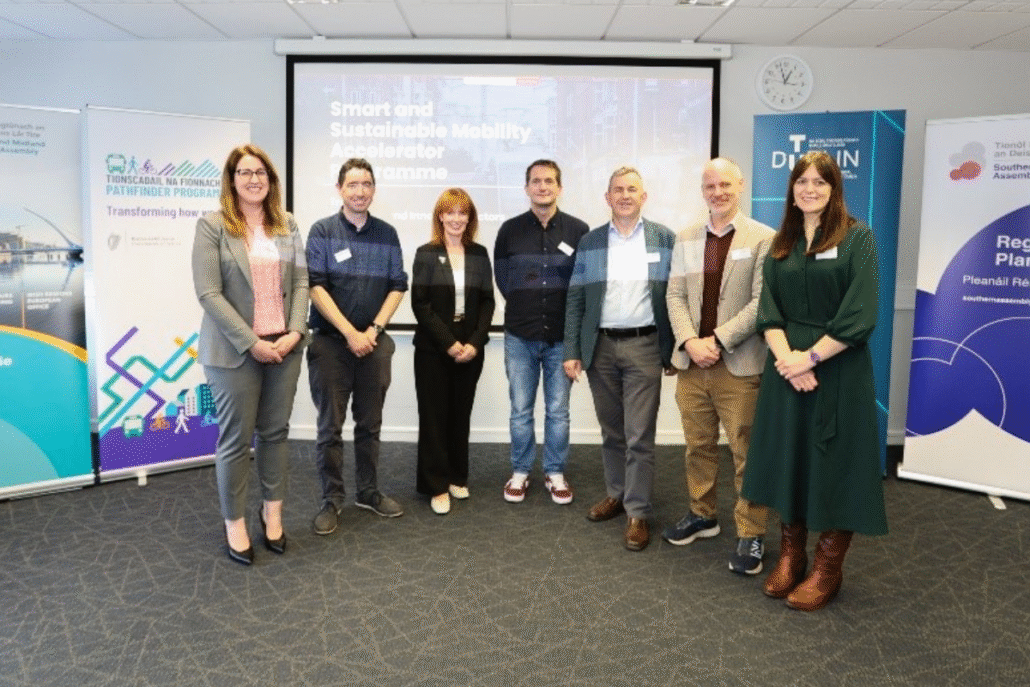
Smart and Sustainable Mobility Accelerator Track 3: Academia and Innovation Actors took place in TU Dublin on 22 October 2025
The SSMA programme and Sustainable Mobility Academy, developed by the Regional Assemblies and BABLE Smart Cities with support from the Department of Transport, offer a comprehensive training and capacity-building series to help local authorities deliver smart and sustainable mobility projects. The initiative enhances knowledge, skills, and collaboration across sectors, enabling participants to develop innovative projects and share best practices. It aligns with the National Sustainable Mobility Policy (SMP) Action Plan 2022–2025.
Track 3 focused on the role of academia and innovation actors in empowering public, private and community sectors with the necessary tools to address challenges and capitalize on opportunities within the Irish transportation sector, fostering more efficient, environmentally friendly, and user-centric mobility systems. The day moved from outlining Ireland’s ambitious national vision, to unpacking this vision through innovation and delivery before working together to co-create solutions for more sustainable journeys.

The workshop highlighted the critical role of academia and innovation actors in shaping Ireland’s sustainable mobility future. A recurring theme was the need to bridge the gap between policy and practice, with local authorities and researchers working more closely to deliver real-world solutions. Behavioural change emerged as a central challenge and while infrastructure is improving, shifting mindsets and habits remains complex and requires deeper engagement with behavioural science. Data was another key focus. While Ireland has strong transport datasets, they are often fragmented and underused. Participants stressed the importance of combining quantitative and qualitative insights to inform inclusive and effective planning.
The co-creation session demonstrated the power of participatory approaches. Breakout groups developed practical solutions targeting technology, behaviour, infrastructure, and open innovation. These exercises revealed common barriers such as poor integration and safety concerns and the opportunity to use communication and a key enabler for change.

Overall, the day reinforced that leadership, collaboration, and experimentation are key to accelerating Ireland’s mobility transition. The SSMA model is proving effective in building capacity across sectors, and participants expressed the desire to further develop the programme.
For additional information regarding training sessions and a wealth of resources, including use cases and forums, we invite you to visit the Sustainable Mobility Academy platform


